Alfred & Emily by Doris Lessing
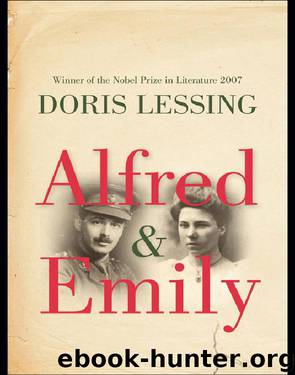
Author:Doris Lessing [Lessing, Doris]
Language: eng
Format: epub
Publisher: HarperCollins
Published: 0101-01-01T00:00:00+00:00
ALFRED TAYLER was a very old man when he died. He came from a long-lived family.
EMILY MCVEAGH saw some boys tormenting a dog and went to remonstrate. They turned on her. It was believed that her shock at this was more the reason for her heart-attack than the blow she received on her head. She was seventy-three years old. Hundreds of people came to her funeral.
Explanation
You can be with old people, even those getting on a bit, and never suspect that whole continents of experience are there, just behind those ordinary faces. Best to be old yourself to understand, if not one of those percipient children made sensitive by having to learn watchfulness, knowing that a glance, a tiny gesture may mean warnings or rewards. Two old people may exchange a look where tears are implicit, or say, ‘Do you remember…’ signposts to something worth remembering for thirty years. Even a tone of voice, a warmth, or irritation, can mark a ten-year love affair, or an enmity. Writing about parents, even alert offspring or children may miss gold. ‘Oh, yes, that was when I was living in Doncaster that summer with Mavis.’
‘You were what? You never mentioned that.’
Writing about my father’s imagined life, my mother’s, I have relied not only on traits of character that may be extrapolated, or extended, but on tones of voice, sighs, wistful looks, signs as slight as those used by skilful trackers.
More than once did my father say, with a laugh, talking about some girl in his youth, ‘But I liked her mother even more.’ From there came Alfred’s intimacy with Mary Lane.
Bert was his childhood friend, a young man’s mate. They had good times together in boys’ pastimes and when Bert went with my father to the races, ‘Oh, I did so love the horses,’ said my father. Meaning the animals themselves. ‘Bert and I went up to Doncaster when we could. But I was on my guard–I could easily be taken over by it all–those horses thundering down the straight with the sun on their hides, the smell of them, the slippery run of your hand on a rump. But Bert wasn’t so cautious, not in that or in anything. I used to have to watch for Bert. He didn’t care enough about himself.’
Once in Banket, in Rhodesia, for no reason I can remember, there was a Danish woman visiting. She was a large, laughing, ruddy-faced woman and I remember to this day sitting as a small girl on her lap, in her arms, thinking, She likes me, she likes me better than my mother does. And my father most certainly did like her. From that afternoon so long ago came Betsy, Alfred’s wife: I enjoyed giving him someone warm and loving.
William, Emily McVeagh’s husband, came from the little picture of my mother’s great love that lived on her dressing-table. But, strange, it was a cutting from a newspaper in that leather frame, not a portrait from a studio or a friendly snap. Yet she talked as if she and he were to be married.
Download
This site does not store any files on its server. We only index and link to content provided by other sites. Please contact the content providers to delete copyright contents if any and email us, we'll remove relevant links or contents immediately.
| Actors & Entertainers | Artists, Architects & Photographers |
| Authors | Composers & Musicians |
| Dancers | Movie Directors |
| Television Performers | Theatre |
Cecilia; Or, Memoirs of an Heiress — Volume 2 by Fanny Burney(31933)
Cecilia; Or, Memoirs of an Heiress — Volume 3 by Fanny Burney(31925)
Fanny Burney by Claire Harman(26591)
We're Going to Need More Wine by Gabrielle Union(19028)
Plagued by Fire by Paul Hendrickson(17398)
All the Missing Girls by Megan Miranda(15915)
Cat's cradle by Kurt Vonnegut(15320)
Bombshells: Glamour Girls of a Lifetime by Sullivan Steve(14046)
For the Love of Europe by Rick Steves(13846)
Leonardo da Vinci by Walter Isaacson(13303)
4 3 2 1: A Novel by Paul Auster(12362)
The remains of the day by Kazuo Ishiguro(8962)
Adultolescence by Gabbie Hanna(8908)
Note to Self by Connor Franta(7663)
Diary of a Player by Brad Paisley(7542)
Giovanni's Room by James Baldwin(7313)
What Does This Button Do? by Bruce Dickinson(6193)
Ego Is the Enemy by Ryan Holiday(5406)
Born a Crime by Trevor Noah(5367)
